
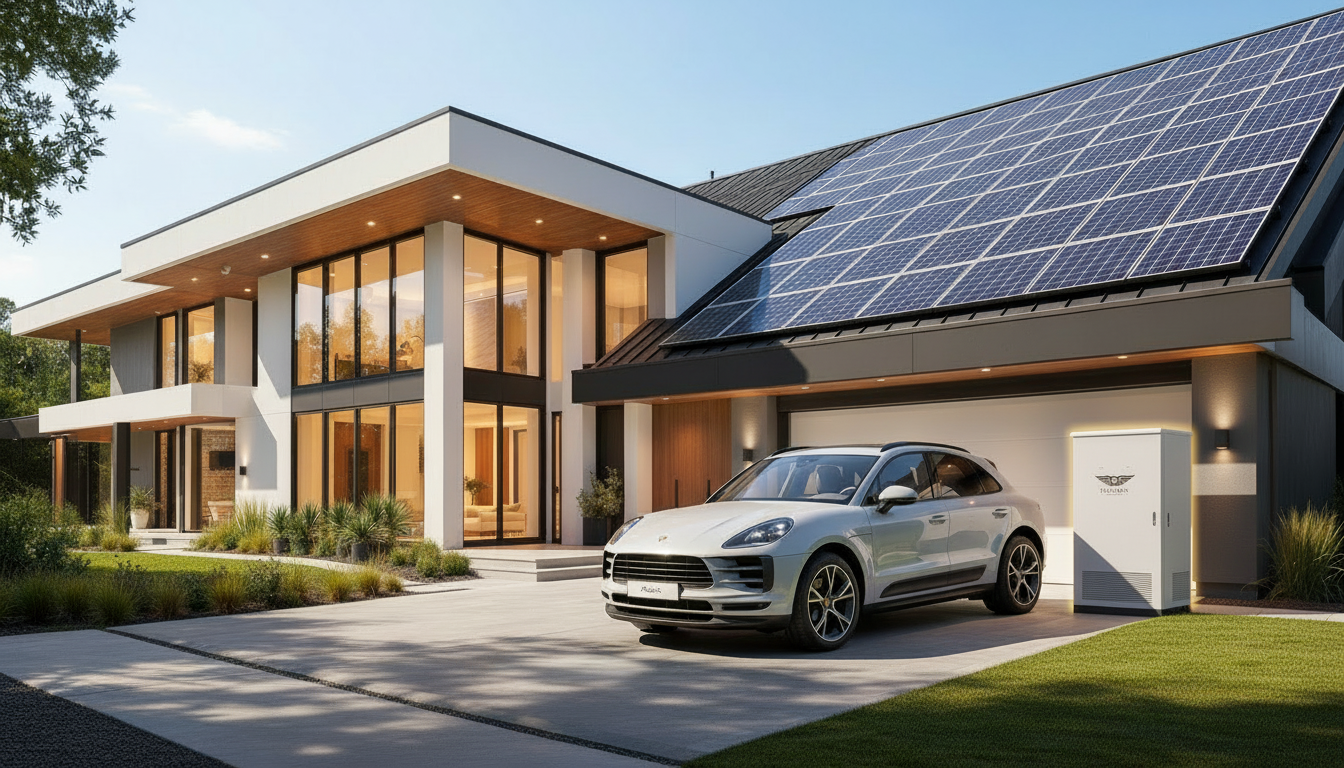
Why now
Power is moving on-site
Demand from AI data centers, rising rates and an aging grid are pushing homes and businesses to produce and store their own power.
~2x
AI data-center load
U.S. data-center electricity demand projected to roughly double by 2030.
+32%
Rising rates
U.S. residential prices, 2020 to 2025. California +59%, Maine +72%.
78%
More outages
Increase in weather-related major outages, 2011-2021 vs. 2000-2010.
Sources: U.S. EIA (data-center demand); American Action Forum, Oct 2025 (residential rates); Climate Central, 2022 (weather-related outages).
The product · In market today
One box that replaces the grid
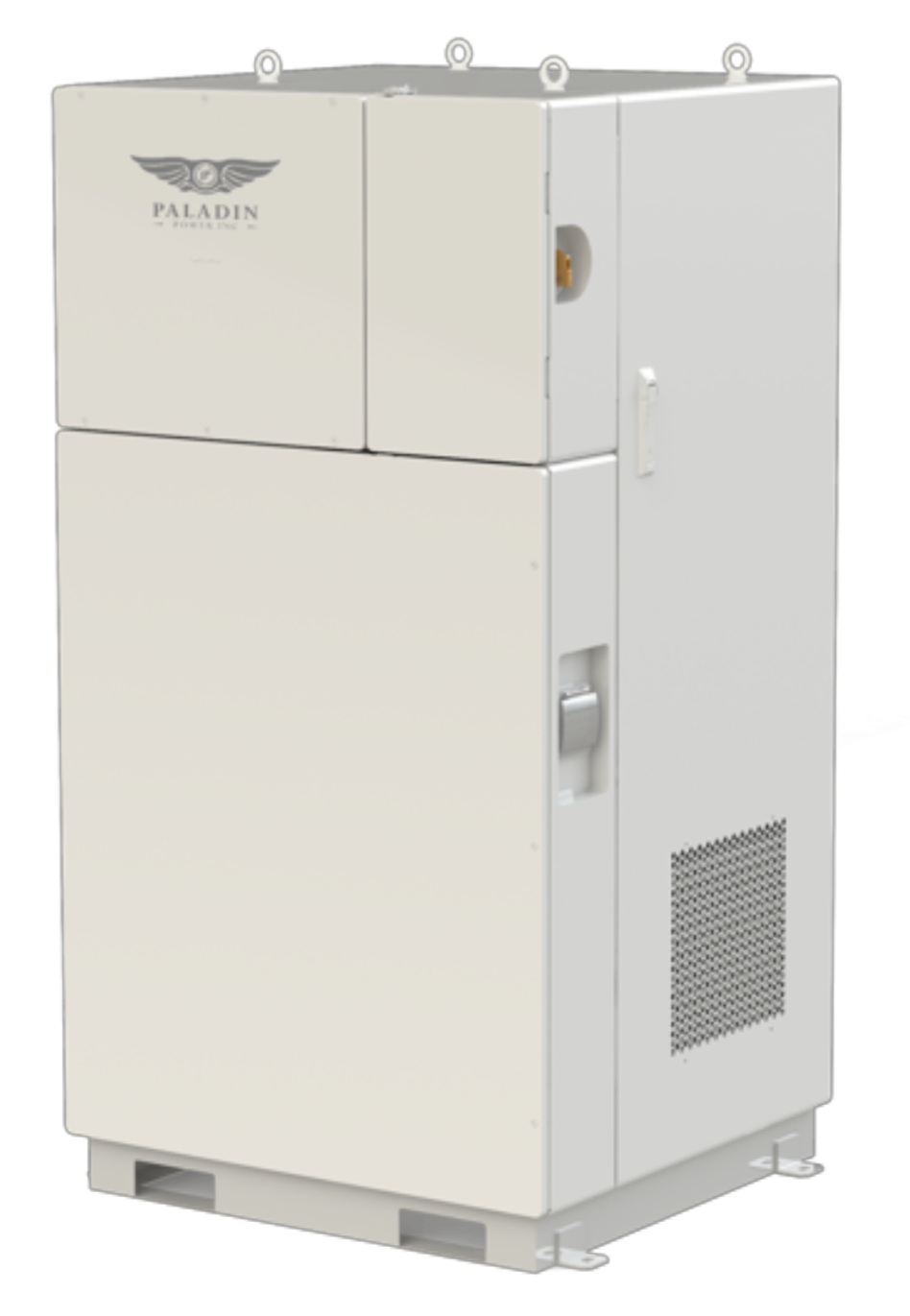
Whole-home power
20 to 40 kW continuous at 240 V. Runs AC, EV chargers and motors.
Scalable storage
30 to 100 kWh models, SB30 to SB100, in a single enclosure.
Solid-state cells
Graphene solid-state chemistry engineered to reduce thermal-runaway risk.
One-day install
Installs and commissions in a day, versus 3 to 7 days for multi-unit stacks.
Tested and certified (current product line): UL 9540A fire testing, UL 1741 SB, Rule 21, CEC listed, IEEE 2030.5, HECO · In review: UL 9540 system listing (Intertek)
The Paladin Advantage
Moving consumers to 2.0 technology
Legacy solar battery providers have it wrong.
Paladin corrects their weaknesses, giving consumers and installers a superior product.
Legacy systems
Powerwall and other legacy providers
The Paladin platform
One box, solid-state, whole home
Designed to back up the grid. The customer still pays the utility.
Designed to use the grid as backup. The customer pays no electric bill.
Multiple units, a large footprint, and a complicated multi-day install to cover all household circuits.
One unit, a small footprint, and a one-day install with every household circuit covered, including electric vehicles.
Higher base price and installation costs to replicate what Paladin does in one box.
Cost-effective for consumers, far more profitable for installers, and a natural choice in the sales channel.
Older liquid-electrolyte battery technology with higher fire risk.
Solid-state batteries engineered to reduce fire risk.
Historic build contracts leave exposure to tariffs on imported units.
All unit construction expected to move to the U.S. in 2027.
Paladin's comparison reflects publicly available specifications and pricing for the products named and has not been independently verified. Paying no electric bill assumes a properly sized system with solar generation; results depend on the site, usage and local utility rules.
Proof in the field
Running off-grid today, not on paper
Off-grid for over a year
Rancho Palos Verdes homeowner whose grid was cut by the 2024 landslides. No generator.
Commercial, 9 months off-grid
A commercial 3D-printing operation in Florida runs on Paladin.
Systems in daily use
Including the founder's own home: family of four, EV and solar on one system.
Traction
Contracted demand and audited results
$1.19B
35,000-unit purchase agreement
Brighthouse Funding LLC, executed July 2026, over 36 months. Units must carry UL 9540 listing at delivery; that listing is in review with Intertek and this round funds its completion. The initial closing has not yet occurred, and there is no assurance of the volumes or timing of orders.
$627K
FY2024 revenue
Audited
$1M+
FY2025 revenue
Audited
~$12M
Raised to date
From 3,700+ investors
2
U.S. utility patents
11,777,149 and 11,955,831, plus provisional application 64/161,589 filed Sept 2026
Manufacturing
Bringing production onshore
San Diego facility
Lease signed for an industrial facility in San Diego. Southern California production capacity is part of the 2027 plan.
Contract manufacturing
Signed master services agreement with a U.S. contract manufacturer for system production that scales with demand.
2 GWh, expandable
Planned U.S. cell capacity under a signed agreement.
Domestic content, rising
Grows with each generation, toward fully FEOC-compliant U.S. production in 2027.
Leadership
The team behind the platform
Ted Thomas
Founder and CEO
Created the single-box ESS concept in 2012; C-10 contractor since 2017; 17 years in finance; Navy veteran.
Eric Sherb
Acting CFO
Licensed CPA with 20+ years in finance.
Allan O'Neil
Operations
16+ years installing and supporting solar and battery storage.
Bruce Miller
Chief Software Engineer
25+ years in embedded systems and real-time design.
Board: Ted Thomas (Chairman), Brian Quock, William Scapell.
Financials and capitalization
The numbers behind the round
Historical results come from PCAOB-audited financial statements, which are provided with the PPM. The 2026 figure and the projections below are management estimates.
Revenue
| Fiscal year | Revenue | Basis |
|---|---|---|
| FY2024 | $627,045 | Audited |
| FY2025 | $1.0M+ | Audited |
| FY2026 target | ~$7M | Management estimate |
The FY2026 figure is unaudited and remains subject to year-end close and audit, including the company's revenue recognition review. The full audited statements, including results of operations and the balance sheet, are in the PPM.
Capitalization at the $15M maximum
| Shares | Ownership | |
|---|---|---|
| Fully diluted before the round | 118,135,312 | 86.3% |
| Class B offered at $0.80 | 18,750,000 | 13.7% |
| Fully diluted after the round | 136,885,312 | 100% |
Pre-money valuation $94M; post-money about $109M at the maximum. Fully diluted counts include 7,630,000 options under the Equity Incentive Plan, per the transfer agent (Colonial Stock Transfer). No warrants are outstanding. Class B carries one vote per share. Class A, all held by the founder, carries ten votes per share, giving the founder voting control.
Pro forma projections, 2027 to 2030
2027 is a ramp year. UL 9540 listing comes first, then a five-month FEOC compliance setup, and Brighthouse deliveries begin in the second half of the year. From 2028 the plan delivers the signed Brighthouse contract in full, alongside direct sales, a growing distributor and builder channel, and commercial projects, reaching full build-out in 2030.
~$1B
Target valuation at listing, late 2027
About 2.1x projected 2028 revenue of $466M, and about 6x projected 2027 revenue, within the 6x to 8x revenue range management uses for the company.
35,000
Brighthouse units, fully delivered by 2030
The plan delivers the full signed contract, starting in the second half of 2027 once UL 9540 listing and FEOC setup are complete.
17,800
Units in 2030
Under half of the 40,000 units a year the planned production capacity supports.
Total revenue
Management estimates and projections
EBITDA
Management estimates and projections
| 2026E | 2027P | 2028P | 2029P | 2030P | |
|---|---|---|---|---|---|
| Brighthouse units delivered | 2,000 | 9,000 | 12,000 | 12,000 | |
| Direct systems sold | 600 | 1,200 | 1,500 | 1,800 | |
| Distributor and builder units | 900 | 1,500 | 2,500 | 4,000 | |
| Brighthouse revenue | $67.8M | $305.1M | $406.8M | $406.8M | |
| Direct sales revenue | $45.0M | $90.0M | $112.5M | $135.0M | |
| Distributor and builder revenue | $30.6M | $51.0M | $85.0M | $136.0M | |
| Commercial projects and Ramona | $14.1M | $20.0M | $30.0M | $40.0M | |
| Total revenue | ~$7M | $157.5M | $466.1M | $634.3M | $717.8M |
| Gross margin | 34% | 34% | 34% | 35% | |
| Operating costs | $22M | $40M | $55M | $65M | |
| EBITDA | $32.0M | $116.4M | $160.3M | $182.8M |
Key assumptions
- Brighthouse: 35,000 SB80-20 units at the $33,900 contract price, delivered against purchase orders from the second half of 2027 through 2030, at a 30% to 33% wholesale gross margin.
- Direct sales: the sales force ramps from about 50 systems a month in 2027 to 150 a month in 2030, at an average of $75,000 per system (battery plus solar) and a 45% gross margin.
- Distributors and builders: wholesale sales to the distributors, installers and home builders in the current pipeline, at about $34,000 a unit and a 30% gross margin.
- Commercial projects: signed contracts rolling from 2026, the Rancho Mirage lagoon project, Ramona, and municipal and commercial bids.
- Operating costs grow from about $22M to $65M as the team, sales force and production scale.
- Section 45X manufacturing credits, grid-services revenue and FluxCapacitor sales are excluded.
These projections and the target valuation are management estimates. They are unaudited and have not been reviewed by the company's auditors. They depend on UL 9540 listing, FEOC-compliant supply, Brighthouse purchase orders and its ability to finance them, the conversion of the pipeline into signed orders, the funding of this round and later financings, and market conditions at the time of any listing. None of these is assured, the valuation at any listing could be materially lower, and actual results may differ materially.
How $15 million gets Paladin to a $1 billion listing
This round is not meant to fund every unit. It funds the steps that unlock revenue. Unit growth is then financed by customer advances and asset-backed debt, and the growth capital for full volume is planned around a public listing.
STAGE 1 · NOW TO MID-2027
The Pre-Listing Round
$15M completes UL 9540 listing, sets up FEOC-compliant production, builds the direct sales force, and carries the inventory and working capital to begin Brighthouse deliveries. It also covers the costs of preparing for a listing.
STAGE 2 · 2027
Orders fund the units
Brighthouse pays a 25% rolling advance on each month's orders, and its purchase orders support PO financing. Direct-sale service contracts are held by Paladin Equity Partners I, LLC and financed through asset-based lending on the contract book and Section 6418 tax credit sales. Equity is not consumed unit by unit.
STAGE 3 · LATE 2027 TO 2030
Listing and growth capital
With audited FY2026 results and a 2027 run rate behind it, Paladin plans a public listing by IPO, Regulation A or merger at a target valuation of about $1B, with a growth raise of about $75M to $100M. That capital funds production at full volume, U.S. cell onshoring and the FluxCapacitor product line through 2030.
The listing, the target valuation and the later financings are plans, not commitments. No listing has been applied for, and there is no assurance of a listing, its timing or valuation, or that later debt or equity financing will be available on acceptable terms. If it is not, growth will be slower than projected.
The offering
$15M Pre-Listing Round
Offered under Rule 506(c) of Regulation D to verified accredited investors.
- Security
- Class B Common Stock
- Price per share
- $0.80
- Maximum raise
- $15,000,000
- Minimum investment
- $10,000
- Pre-money valuation
- $94M
- Shares offered
- Up to 18,750,000
- Verification and payments
- EquiDeFi
- Offering period
- Through July 31, 2027
- Extendable up to 120 days
$9M · 60%
Manufacturing and product
U.S. production facility and equipment, the next-generation system and onshoring of cell supply.
$6M · 40%
Certification, R&D and operations
UL 9540 listing, R&D, listing and legal costs, sales, G&A and working capital.
Allocation per the use-of-proceeds table in the Private Placement Memorandum dated Aug 4, 2026, at the $15M maximum.
Key risks
- Early-stage company with a limited operating and revenue history.
- Sales to grid-connected customers and the Brighthouse agreement depend on UL 9540 system listing, which is still in review.
- Delivery delays to some existing customers, and pending litigation, including customer claims.
- Reliance on imported components and suppliers during the move to U.S. production.
- The founder controls the vote through Class A shares.
- Future financings will dilute investors. The shares are illiquid, and a listing may never happen.
This is a summary only. Read the full Risk Factors section of the PPM.
Offering documents
- Private Placement Memorandum dated Aug 4, 2026
- Subscription Agreement
- PCAOB-audited financial statements, FY2024 and FY2025
- Form D, filed with the SEC (public on EDGAR)
Available to verified investors through EquiDeFi, or request them by email.
Pre-listing: Paladin is preparing for a potential public listing (IPO, direct listing, Regulation A or merger). No listing has been applied for or approved; route and timing are undecided, and no listing or trading market is assured. The shares are restricted securities with no trading market, and a listing would not by itself make them freely transferable.
How to invest
Three steps to become a shareholder
Verify accreditation
Complete accredited-investor verification through EquiDeFi, as Rule 506(c) requires.
Review the PPM
Read the Private Placement Memorandum, risk factors and subscription agreement before you invest. Request the PPM.
Subscribe and fund
Sign electronically and fund through EquiDeFi. Minimum $10,000.
Questions or to request the PPM: Investor Relations, Derek Cahill · 949-285-9424 · dc@paladinpower.com